
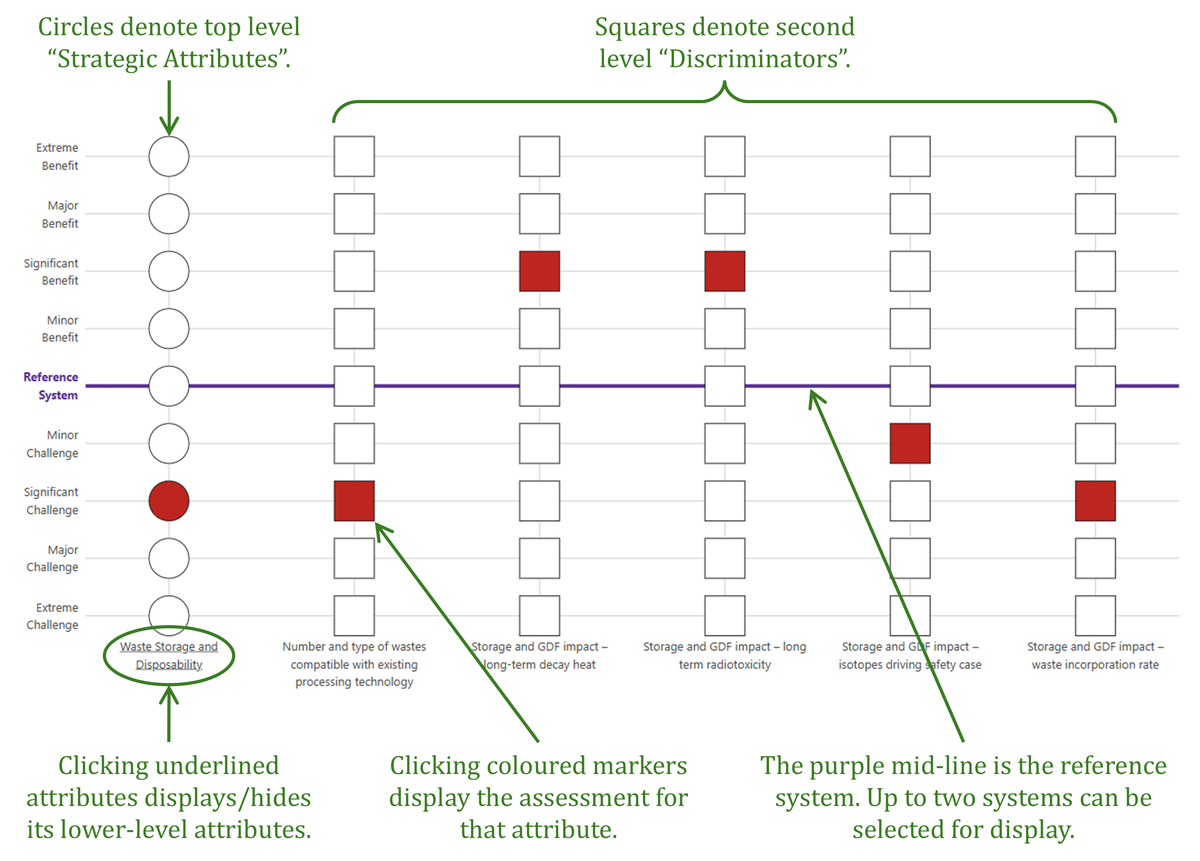
Which attributes are most important change over time, so GFA does not weight its attributes, instead allowing users to make that value judgement themselves.
GFA was developed as part of Project 3 for a 2016 Department of Energy and Climate Change independent Techno-Economic Assessment of SMRs, following Phase One of the 2016 SMR Competition. In 2025 GFA was moved online to improve accessibility and in 2026 workshops were held to update the assessments from the 2016 edition. The updated tool was made available online in June 2026. The 2016 edition of GFA is still available at the link at the bottom of this page.
Please not that this website is not optimised for mobile devices, so the use of a desktop computer is recommended.
Click here to start using GFA
Background to GFA
Multi-Attribute Decision Analysis (MADA)
MADA is the common method of comparing complex systems. In this method a group of attributes are defined to cover the main parameters of the systems, and scores are allocated depending on how well or badly a system performs. For an automotive example, a supermini might score well on "fuel economy", whereas an off-road 4x4 would likely score badly. Not all parameters carry the same importance: "Engine reliability" will likely be judged to be more important than the "range of paint colours available" for each vehicle type. Compiled scores are therefore weighted accordingly and these weighted scores combine to provide an overall consolidated score for the systems being compared. A subsequent large increase in fuel prices would likely shift the priorities of users, but a fixed MADA would not reflect such a change. GFA seeks to avoid weightings to enable users to apply their own priorities.
NNL Assessment of Nuclear Technologies
In 2012/3, the National Nuclear Laboratory (NNL) developed a methodology to examine nuclear power systems, based on 42 metrics derived from those used by the Generation IV International Forum. These were subsequently divided into seven groups (Cost, PRPP, Safety, Strategic, Deployability, Sustainability, Waste) and used to assess advanced reactor systems. While the scores from these analyses defined winners and losers, the approach suffered from two main disadvantages:
- The use of a MADA with a large number of metrics makes the result very difficult to communicate meaningfully, even to committed stakeholders.
- The suitability of a reactor system depends very strongly on the world in which it must operate. For different times and locations, the suitability will vary. For example, systems which score highly for uranium economy (e.g. fast reactors) should be highly weighted in a future with limited uranium supply, but less so in a future where uranium is plentiful and cheap.
Development of GFA
Following this, collaborative efforts from the Dalton Nuclear Institute, Integrate Decision Management (IDM) and NNL evolved GFA. The system data from the complex NNL analyses are utilised, but are accumulated into a more useable number of Strategic Attributes (12), and are assessed by pairwise comparison to a reference system. This was initially to be a contemporary Pressurised Water Reactor (PWR) with a once-through cycle, for which many of the parameters were already well understood.
The comparisons made are based on published data which can be referenced, linked and made publicly available. The result is an analysis which relies on easily assimilated graphics and words, rather than complex and opaque marking systems.
GFA has been applied to several advanced reactor systems, and was deployed most recently to assess Small Modular Reactors (SMRs) as part of the 2016 Independent Techno-Economic Assessment (TEA) of SMRs for the Department of Energy and Climate Change. The final report was supported by an extensive literature review of the subject area.
GFA in 2016
The 2016 GFA tool is available here, and has been transferred from its original format to this openly available browser version which we hope is more accessible to users. GFA was updated in June 2026. Those interested in comparisons with the 2016 GFA should be aware that some assessments may be outdated, and some terminology has moved on since 2016.
Further Information
- Background information at The University of Manchester's Beam nuclear and social research network website.
- A 2021 journal article on GFA.